
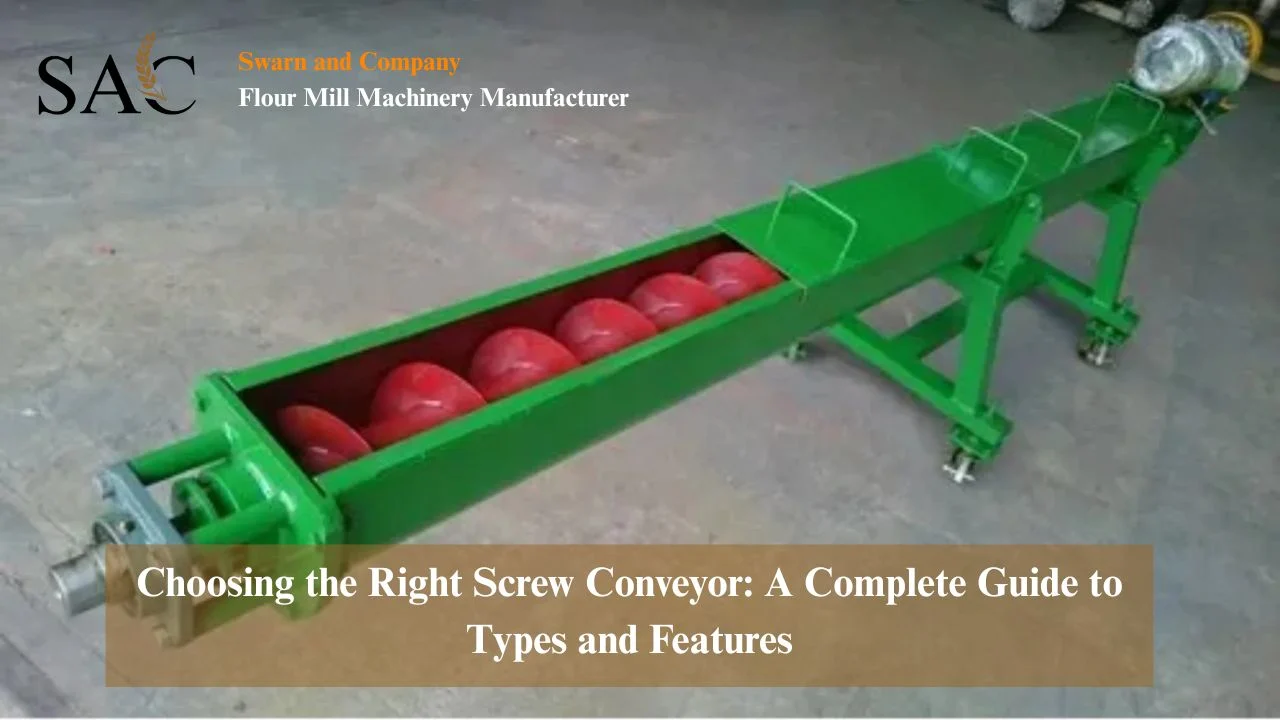
Swarn and Company understands that material handling is the backbone of efficient industrial operations. Among the many conveying solutions available today, the screw conveyor remains one of the most reliable and widely used systems. Our focus is on engineering systems that offer reliability, efficiency, and long service life. We provide dependable screw conveyor solutions designed for smooth, controlled material flow.
What Is a Screw Conveyor and Why Is It Important?
Screw conveyors are valued for their simplicity, compact design, and ability to handle a wide variety of materials. From fine powders to semi-solid materials, screw conveyors ensure consistent movement with minimal spillage. Their enclosed structure also helps maintain hygiene and reduce material loss, making them ideal for controlled environments.
Specialized Types of Screw Conveyor
- Shaftless Screw Conveyor: This design eliminates the central shaft, making it suitable for sticky, fibrous, or irregular materials such as sludge or waste. Swarn and Company offer shaftless options for challenging material handling needs.
- Flexible Screw Conveyor: Flexible conveyors are used for transporting powders and granules over curved paths. They are common in food and pharmaceutical industries due to their adaptability.
- Twin Screw Conveyor: Twin screw conveyors use two intermeshing screws for higher capacity and improved mixing. They are ideal for heavy-duty and high-throughput applications.
These advanced screw conveyor types allow businesses to customize solutions based on material behavior and processing requirements.
Also Read : Exploring Roller Mills: Essential Machinery for Grain Processing
Features to Consider When Choosing a Screw Conveyor
- Material Characteristics: The nature of the material—whether it is abrasive, sticky, corrosive, or free-flowing—plays a major role in selecting the right conveyor design.
- Conveyor Length and Capacity: Longer conveyors require precise design to maintain consistent flow. Capacity requirements also influence screw diameter and pitch.
- Construction Material: Food-grade stainless steel is used for hygienic applications, while carbon steel is suitable for heavy industrial use. Swarn and Company ensures its products offer durability through high-quality materials.
- Drive and Power Requirements: Efficient motors and gearboxes ensure smooth operation and energy savings. Power selection depends on conveyor length, material load, and operating angle.
Benefits of Using the Right Screw Conveyor
Choosing the correct types of screw conveyor offers several advantages:
- Improved material flow control
- Reduced maintenance and downtime
- Better energy efficiency
- Safer and cleaner operations
- Longer equipment lifespan
Swarn and Company designs systems that offer these benefits across diverse industries.
Why Choose Swarn and Company?
Swarn and Company stands out due to its focus on quality engineering, practical design, and customer-centric approach. With deep industry experience, our company understands how different screw conveyor types perform in real-world conditions. Every system is designed to deliver consistent performance, safety, and ease of maintenance. We provide customized, high-performance conveyors, Swarn and Company helps businesses streamline operations and improve productivity.
Understanding the various types of screw conveyor and their features is essential when making an investment in material handling equipment. From horizontal and inclined systems to advanced shaftless and twin screw designs, each option serves a unique purpose. Swarn and Company continues to offer reliable screw conveyor solutions that meet modern industrial demands. Choosing the right conveyor today ensures smoother operations, lower costs, and long-term efficiency for your business.