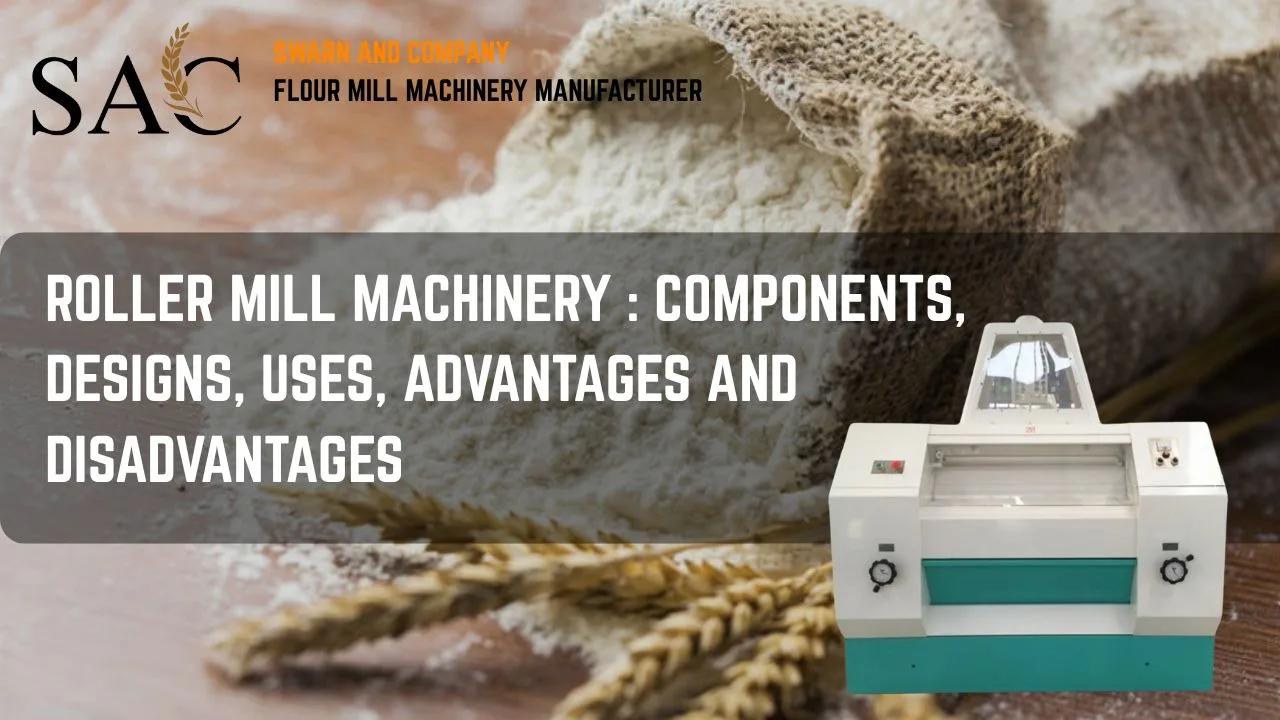
Swarn and Company is a leading name of roller mill machinery manufacturers, we provide high-performance roller mill machinery designed to meet the demands of modern industries. We understand what businesses need when it comes to consistency, durability, and smooth operations. A roll mill works on a simple but effective principle crushing and grinding materials between rotating steel rollers. Whether in flour mills, chemical plants, or mineral industries, the roller mill continues to be a preferred choice because of its efficiency and easy maintenance.
Key Components of a Roller Mill
A modern roller mill machinery setup includes several essential components working in harmony to deliver precision grinding:
- Grinding Rollers: These rollers are made from high-grade steel and designed to efficiently crush materials. The gap between the rollers can be adjusted to get the desired particle size.
- Feeder System: It ensures a uniform flow of raw material into the mill. An efficient feeder helps maintain consistent grinding without overloading the system.
- Grinding Chamber: This is the enclosed space where materials pass through the rotating rollers. It is designed for minimal wastage and maximum output.
- Drive Mechanism: The motor and gearbox provide the necessary power for the rollers to rotate at controlled speeds. Reliable drive systems ensure the long life of the roll mill.
- Discharge System: After grinding, the finished product exits through the discharge system, ensuring controlled flow and easy material handling.
Also Read : What Makes Maida Flour Different from Wheat Flour?
Designs of Roller Mill Machinery
Swarn and Company, being one of the experienced roller mill machinery manufacturers, offers different designs based on industrial requirements. Some of the commonly used designs include:
- Single Pair Roller Mill: Ideal for coarse grinding and basic crushing applications. Mostly used in small flour mills and feed processing units.
- Double Pair Roller Mill: This design enhances grinding precision by passing materials through two pairs of rollers, ensuring finer output and improved consistency.
- Triple Pair Roller Mill: Perfect for industries that require fine grinding in one go. Used commonly in food and chemical industries.
- Vertical Roller Mill: A space-saving design where rollers are positioned vertically. Highly efficient for minerals, cement, and industrial powders.
- Industrial Roll Mills: Heavy-duty mills used for processing chemicals, pigments, and bulk materials where precision control is required.
Each design aims to improve energy efficiency, maintain uniform particle size, and reduce operational downtime.
Uses of Roller Mill Machinery
The roller mill has diversified applications across several industries:
- Flour and Grain Milling: One of the most common uses. Rollers crush wheat, maize, rice, barley, and other grains to produce refined flour.
- Animal Feed Production: Roller mills help achieve the right texture for animal feed, making digestion easier for livestock.
- Chemical Industry: Used for grinding pigments, chemicals, and additives to achieve uniform particle structure.
- Mining and Mineral Processing: Roller mills grind ores, stones, and minerals into fine powders for further processing.
- Food Industry: Various food ingredients such as spices, coffee beans, and cereals are processed using roll mills for consistency and quality.
- Pharmaceutical Production: Used for crushing raw medicinal ingredients into fine, uniform powder.
Advantages of Roller Mill Machinery
The increasing preference for roller mills is due to their several performance benefits:
- Superior Grinding Efficiency: Roller mills deliver high output with low energy consumption, making them ideal for long-term industrial use.
- Uniform Particle Size: The adjustable roller gap ensures consistent grinding quality, which is essential in flour and feed production.
- Low Heat Generation: Unlike hammer mills, the roller mill machinery produces less heat, preserving the nutrient value in food and feed materials.
- Easy Maintenance: Rollers and internal components can be quickly replaced, reducing downtime.
- Cost-Effectiveness: Long service life, low operational costs, and high efficiency make roller mills a profitable investment.
Disadvantages of Roller Mill Machinery
Although efficient, roller mills also come with certain limitations:
- Higher Initial Investment: Roller mills cost more upfront compared to basic grinding machines.
- Limited Capacity for Hard Materials: Extremely hard or abrasive materials may wear down rollers quickly.
- Requires Skilled Operation: To maintain precision grinding, trained operators are often needed.
- Not Suitable for Very Fine Powder: For ultra-fine grinding, specialized equipment may be required.
The roller mill is an essential machine across industries due to its precision, efficiency, and adaptability. At Swarn and Company, we deliver top-quality roller mill machinery that combines modern engineering with long-lasting performance. We consistently offer and provide reliable solutions for businesses seeking efficiency, low maintenance, and superior output. If you’re looking for trusted roller mill machinery manufacturers, Swarn and Company is here to deliver the right solutions with a human touch and unmatched dedication.